
Monofocal vs multifocal vs EDOF lenses: a side-by-side guide
Last updated November 18, 2026.

Before cataract surgery, you may be asked to choose between a monofocal lens, an extended depth of focus (EDOF) lens, and a multifocal lens. This page puts the three side by side. Each one is described with the same three questions: what it aims for, its trade-offs, and who might ask about it.
No lens category is better than the others for everyone. Results vary by eye and by surgeon, and this page will not tell you which lens to pick. That choice belongs to you and your surgeon.
A note on names: our cataract lens guide calls multifocal and trifocal lenses "full range". On this page we use "multifocal", the word most people search for. Both names mean the same category.
At a glance
- Monofocal: one focus, set for far, arm's length, or near. You'll need glasses for the other distances.
- EDOF: one focus stretched to cover far through arm's length. Readers are common for small print.
- Multifocal: more than one focus, designed for far, arm's length, and near. Halos and glare are more common.
- Every lens may cause some halos at night. For many people they become less noticeable over time.
- Toric lenses and monovision are related options that can work with these categories. They are not categories of their own.
Side by side
The three categories differ mainly in how many distances they are designed to cover, and in what you may notice in exchange.

| Monofocal | EDOF | Multifocal | |
|---|---|---|---|
| How the optics work | One focus, set for one distance | One focus, stretched over a longer span | Two or three focuses (bifocal or trifocal) |
| What it aims for | Better vision at the chosen focal point: far, arm's length, or near | Far through arm's length | Far, arm's length, and near |
| Glasses afterward | You may still need glasses for your best vision at the chosen distance. At other distances, you'll need glasses. | Many people see a computer or dashboard without glasses. Readers are common for small print. | Many people do most of the day without glasses. Some keep readers for small print or dim light. |
| Halos and glare | Possible, as with any lens | Possible. Small studies have not shown whether they differ from trifocals. | More common than with monofocals in studies that assigned lenses by chance |
| Contrast in dim light | The usual comparison point for other lenses | Varies by design. One EDOF label warns of a significant loss compared with a monofocal. | Can be lower than with a monofocal |
| Getting used to it | Some adjustment, as with any lens | Can take weeks | Can take weeks to months |
The three categories, one framework
Each card below answers the same three questions in the same order. Risks that apply to every lens, such as infection, swelling, or needing a laser later for a cloudy capsule, are covered in the Risks section of our lens guide.
Monofocal lens
- What it aims for
- A monofocal lens has one focus. You and your surgeon choose where to set it: far, arm's length, or near. It aims for better vision at the chosen focal point, though you may still need glasses for your best vision there. At other distances, you'll need glasses.
- Trade-offs
- Glasses for the distances it isn't set for. Halos and glare can still happen, as with any lens, though randomized trials found them less often than with multifocals. Enhanced monofocals are a newer type designed to stretch a little into arm's length. A review of studies of one enhanced monofocal found a small improvement at arm's length, with similar safety findings. You'll still need glasses for near, and often for some arm's-length tasks.
- Who might ask about it
- People who are fine wearing glasses for some tasks, or who want the simplest optics, often talk through this category. People with another condition affecting the retina or optic nerve should ask their surgeon how it affects each lens type. A monofocal is a well-established, complete option. Choosing it is a real decision, not a fallback.
Extended depth of focus lens (EDOF)
- What it aims for
- An EDOF lens stretches one focus so it covers a longer span, from far into arm's length, instead of splitting light into separate focuses.
- Trade-offs
- Near vision is usually more limited than with a multifocal. In one study included in a Cochrane review, more people with an EDOF lens than with a trifocal needed glasses to read the small-print line on a reading card. Contrast in dim light may be lower than with a monofocal. The FDA label for one EDOF lens says most people who receive it are likely to have a significant loss of contrast compared with a monofocal, and should take care in dim light, including when driving at night. Halos and glare can occur.
- Who might ask about it
- People who want to depend less on glasses for driving and computer work, and who don't mind readers for small print, often talk through this category with their surgeon.
Multifocal lens (full range)
- What it aims for
- A multifocal lens uses more than one focus, two in a bifocal and three in a trifocal, so far, arm's length, and near are all covered.
- Trade-offs
- Halos and glare are more common. A Cochrane review found that people with a multifocal lens were less likely to need glasses, but more likely to notice halos and glare than people with a monofocal. Contrast in dim light can be lower, and getting used to the lens can take longer. These designs also depend more on a healthy retina, optic nerve, and eye surface.
- Who might ask about it
- People whose main goal is the widest range without glasses, and who are ready to discuss a higher chance of halos and glare, often talk through this category with their surgeon.
EDOF vs multifocal: where they differ
These two categories are the ones people most often weigh against each other, because both aim to reduce dependence on glasses. Here is what the reviews say so far:
- Distance: a Cochrane review comparing trifocal and EDOF lenses found distance vision may be similar with either.
- Near: people with a trifocal may have better near vision and may depend less on glasses for near work.
- Halos and glare: multifocal and trifocal lenses tend to bring more halos and glare. An overview of research and a Cochrane review found halos and glare more common with multifocal lenses than with monofocals. In the trials comparing trifocal and EDOF lenses directly, both caused them, and the trials were too small to show a meaningful difference. One 2022 network analysis found no statistical difference in glare or halos between multifocal and monofocal lenses, so results vary between studies.
Researchers have limited confidence in these findings, and most studies looked at only a few lens models. Ask your surgeon how the specific lenses you are considering compare for eyes like yours.
Every lens may cause some halos
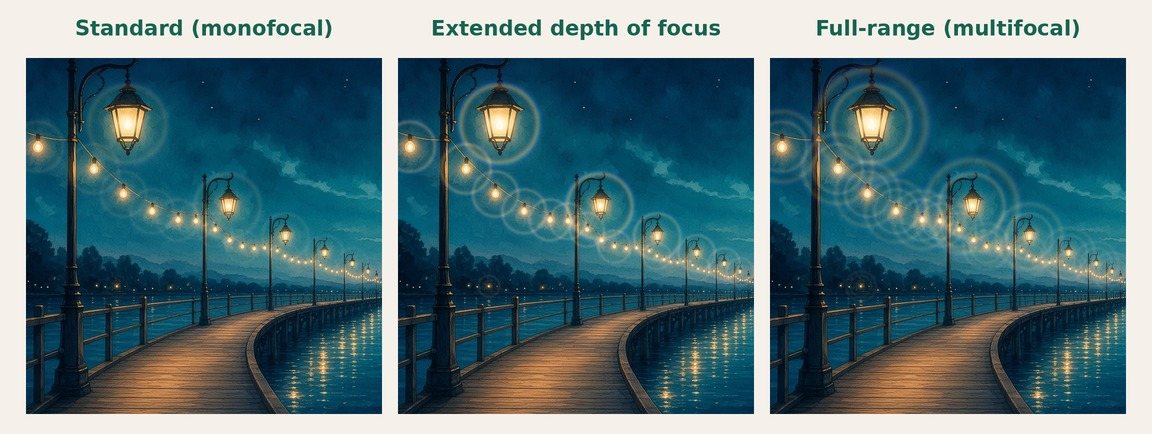
Halos are rings of light around headlights and street lamps. Every lens may cause some halos at night, monofocals included. They are more common with lenses designed for more than one distance. Over time, the brain often learns to tune them out, a process called neuroadaptation, so for many people halos become less noticeable over the first months. Some people stay bothered by them.
In one FDA study of a trifocal lens, more people noticed halos than in the monofocal group. Noticing a halo and being very bothered by it are different measures. Sources: PanOptix SSED, P040020/S087, Tables 20–21. Studies used different questionnaires, so their results should not be ranked against each other.
Related options: toric lenses and monovision
These are not separate lens categories. They can be combined with a lens type, depending on your eyes and your goals.
Toric lenses
A toric lens is designed to correct astigmatism inside the eye. Astigmatism means the front of the eye is shaped more like a football than a basketball, and it can blur vision at every distance. Toric versions exist in all three categories: monofocal, EDOF, and multifocal.

Not every eye benefits. If your astigmatism is small or irregular, a toric may not help. A toric lens also has to be lined up at an exact angle, and it can rotate after surgery. Ask your surgeon whether your eye has enough regular astigmatism to benefit.
Want a fuller explanation of toric lenses, rotation, and other ways to treat astigmatism? See Toric lenses and astigmatism at cataract surgery.
Monovision
Monovision is a setup, usually with monofocal lenses. One eye is set for far and the other for near, or for arm's length in a milder version called mini-monovision. Together, the two eyes cover more distances. You may still need glasses for some tasks, such as night driving or long reading.

In the Cochrane review, people with multifocal lenses were less likely to need glasses than people with monovision, but more likely to report glare. Depth perception can be lower with monovision. If you've never tried it, ask whether you can test it with contact lenses before surgery.
Your eye health can narrow the choice. Prior LASIK, macular degeneration, glaucoma, dry eye and other conditions can change which lenses are a reasonable fit. See Your eye decides what's possible in our lens guide, along with the light-adjustable lens and how lens power is chosen.
Questions to bring to your consult
- Which of the three categories are possible for my eyes, and why not the others?
- With each option, what will I still need glasses for?
- What halos, glare, or dim-light changes should I expect with each, and how long do they usually take to fade?
- For the EDOF and multifocal lenses you use, how do they compare for near vision?
- Do I have enough regular astigmatism for a toric lens to help?
- Would monovision work for me, and can I try it with contact lenses first?
- Does anything about my eyes (LASIK, retina, glaucoma, cornea, dry eye) rule out a category?
Want a fuller list, including goals, measurements, and what to ask if the focus lands off target? See Questions to ask your surgeon about cataract lenses.
Want to talk it through before the lens is implanted?
ClarityIQ is a guided voice conversation, built by a cataract surgeon, that walks you through your goals and these lens categories at your own pace — before your consult, after it, or as a second look. You get a written summary to bring to your surgeon. Or read our full lens guide first.
Frequently asked questions
Which is better: a monofocal, multifocal, or EDOF lens?
None is better for everyone. Each category is designed for different goals and comes with different trade-offs. Which one fits depends on what you want to see without glasses, how much halo, glare or dim-light change you would accept, the health of your eyes, and your surgeon's exam.
Is an EDOF lens the same as a multifocal lens?
No. A multifocal lens has two or three separate focuses. An EDOF lens stretches one focus over a longer span, from far into arm's length. Multifocals usually cover near better. Multifocals tend to bring more halos and glare, though results vary between studies.
Will I need glasses with a monofocal lens?
Yes, for some things. A monofocal aims for better vision at the chosen focal point, though you may still need glasses for your best vision there. At other distances, you'll need glasses.
Will the halos go away?
Every lens may cause some halos at night. For many people they become less noticeable over time as the brain adapts, a process called neuroadaptation. Some people stay bothered by them. Ask your surgeon what to expect with the lenses you are considering.
Can I get a toric version of each lens type?
Toric versions exist in all three categories. Whether one will help depends on how much regular astigmatism your eye has.
Does ClarityIQ tell me which lens to choose?
No. ClarityIQ explains what each lens category is designed to offer and its trade-offs, so you can have a better conversation with your surgeon. You and your surgeon make the choice together.
Sources
Figures on this page come from the peer-reviewed papers and FDA documents below. Studies used different methods and questionnaires, so the numbers should not be averaged or ranked against each other.
- de Silva SR, Evans JR, Kirthi V, Ziaei M, Leyland M. Multifocal versus monofocal intraocular lenses after cataract extraction. Cochrane Database of Systematic Reviews. 2016;12:CD003169. PMID 27943250. doi:10.1002/14651858.CD003169.pub4.
- Tavassoli S, Ziaei H, Yadegarfar ME, Gokul A, Kernohan A, Evans JR, Ziaei M. Trifocal versus extended depth of focus (EDOF) intraocular lenses after cataract extraction. Cochrane Database of Systematic Reviews. 2024;7:CD014891. PMID 38984608. doi:10.1002/14651858.CD014891.pub2.
- Daka Q, Henein C, Fang CEH, Mustafa R, Cocaj E, Azuara-Blanco A, Willoughby CE, Bokre D, Nanavaty MA. Effectiveness of intraocular lenses designed to correct presbyopia after cataract surgery: an overview of systematic reviews. British Journal of Ophthalmology. 2025;109(12):1323-1329. PMID 40623803. doi:10.1136/bjo-2025-327363.
- Cho JY, Won YK, Park J, Nam JH, Hong JY, Min S, Kim N, Chung TY, Lee EK, Kwon SH, Lim DH. Visual outcomes and optical quality of accommodative, multifocal, extended depth-of-focus, and monofocal intraocular lenses in presbyopia-correcting cataract surgery: a systematic review and Bayesian network meta-analysis. JAMA Ophthalmology. 2022;140(11):1045-1053. PMID 36136323. doi:10.1001/jamaophthalmol.2022.3667.
- Loh NC, Pothakamuri TK, Chen DZ. Enhanced monofocal versus conventional monofocal intraocular lenses: a systematic review and meta-analysis of randomized controlled trials. Canadian Journal of Ophthalmology. 2026;61(1):12-19. PMID 40840532. doi:10.1016/j.jcjo.2025.07.010.
- Zhang L, Lin D, Wang Y, Chen W, Xiao W, Xiang Y, Zhu Y, Chen C, Dong X, Liu Y, Chen W, Lin H. Comparison of visual neuroadaptations after multifocal and monofocal intraocular lens implantation. Frontiers in Neuroscience. 2021;15:648863. PMID 34194292. doi:10.3389/fnins.2021.648863.
- Rosa AM, Miranda ÂC, Patrício MM, McAlinden C, Silva FL, Castelo-Branco M, Murta JN. Functional magnetic resonance imaging to assess neuroadaptation to multifocal intraocular lenses. Journal of Cataract & Refractive Surgery. 2017;43(10):1287-1296. PMID 29120714. doi:10.1016/j.jcrs.2017.07.031.
- AcrySof IQ PanOptix, PMA P040020/S087: SSED (Tables 20–21).
- AcrySof IQ Vivity, PMA P930014/S126: labeling (Warnings, contrast in dim light).
This page is education, not medical advice. It doesn't diagnose anything or tell you which lens to choose, and it doesn't make ClarityIQ your doctor. Your surgeon decides with you, based on your exam.