
Cataract lens options: a plain-language guide
Last updated November 18, 2026.

During cataract surgery, the cloudy lens inside your eye is removed and replaced with an artificial lens. This new lens is called an intraocular lens, or IOL. The lens is meant to stay in your eye for the rest of your life, so it helps to understand your options before the lens is implanted.
Every lens has trade-offs, and results vary by eye and by surgeon. Many people today reach their goal of depending less on glasses.
Cataract surgery is designed to remove the cloudy lens. How much your vision improves also depends on the health of the rest of your eye. This guide starts with your goals, then what the three lens categories offer, then add-ons, risks, and what your own eyes may allow. It will not tell you which lens to pick. That choice belongs to you and your surgeon.
At a glance
- Start with two goals: how much you want to depend on glasses, and which distances matter most.
- There are three lens categories: monofocal, extended range (EDOF), and full range. A monofocal can be aimed at far, arm's length, or near.
- Toric lenses, monovision, and light-adjustable lenses are add-ons or setups that can work with a lens type; they are not categories of their own.
- Your eye health and the measurements taken before surgery decide what is possible.
- Every operation carries some risk. The Risks section covers the ones to discuss with your surgeon.
Start with your goals
Before you look at lens types, it helps to sit with two questions. Your answers, plus the health of your eyes, shape most of the conversation with your surgeon.

1. How much do you want to depend on glasses?
- Low: you'd like to do most of your day without them.
- Don't mind: glasses are fine either way.
- Prefer glasses for some tasks: you'd rather wear glasses for some work and keep the lens simpler.
2. Which distances matter, and which matters most?
- Far (distance): driving, watching TV, reading road signs, or seeing faces across the room.
- Arm's length: a computer screen, a car dashboard, or a cutting board.
- Near: a phone, a book, a menu, or small print.
A few more prompts are worth writing down before your visit:
- If you are nearsighted and you currently read without glasses, setting both eyes for distance means you will likely need glasses for near work. A monofocal can be aimed at far, arm's length, or near, so you can talk about keeping that near vision if it matters to you.
- If you drive a lot at night, ask how each option behaves with halos, glare, and contrast in dim light. That discussion belongs with the Risks section later on this page.
- Think about the distances you actually use. A desktop monitor usually sits about arm's length, while a laptop or tablet often sits closer. Hobbies such as golf, sewing, or music can also change which distance matters most.
- If monovision interests you — one eye set for far and the other for near or arm's length — ask whether you can try it with contact lenses first.
Benefits
Cataract lenses fall into three categories. Each is designed for different goals. No category is better than the others in every situation. The right fit depends on your goals and your exam. The same format is used for each category below. Add-ons and setups are in the next section, and risks that can apply with any lens are covered later on this page.
Comparing two or three of these side by side? See monofocal vs multifocal vs EDOF lenses for a comparison table and what the research says.
Some references also describe accommodating lenses, which are designed to change focus with the eye's own focusing muscle. This page does not confirm whether any are on the US market now. Ask your surgeon if that type comes up.

Monofocal lens
How it works: A monofocal lens has one focus, set for a single distance.
Range: A monofocal can be aimed at far, arm's length, or near. For the other distances, you'll need glasses.
Who it tends to suit: People who are fine wearing glasses for some tasks, or who want the simplest optics, often talk through this category. A monofocal lens is a well-established, complete option. Choosing it is a real decision, not a fallback.
This category also includes enhanced monofocals. They're designed to stretch a little into arm's length. You'll still need glasses for near, and often for some arm's-length tasks.
Extended range lens (EDOF)
How it works: An extended-range lens is designed to stretch one focus so it covers a longer span, from far into arm's length, instead of creating separate focuses for each distance.
Range: Many people can see a computer screen or a dashboard without glasses. Glasses are still common for small print and for some work in dim light.
Who it tends to suit: People who want to depend less on glasses for far and arm's-length tasks, and who are ready to discuss contrast in dim light and night driving, often talk through this category with their surgeon.
Full range lens (multifocal or trifocal)
How it works: A full-range lens is designed with more than one focus so you can use far, arm's length, and near.
Range: Many people can do most of their day (driving, computer, phone) without glasses. Some still keep readers for small print or dim light. Your surgeon can tell you how that tends to go for eyes like yours.
Who it tends to suit: People whose main goal is the widest range without glasses, and who are ready to discuss a higher chance of halos and glare, often talk through this category with their surgeon.
Add-ons and setups
These are not separate lens categories. They can be combined with a lens type, depending on your eyes and your goals.
Toric lenses
A toric lens is designed to correct astigmatism inside the eye. Astigmatism means the front of the eye is shaped more like a football than a basketball. It can blur vision at every distance. A toric can be added to all three categories: monofocal, EDOF, and full range.

If your eye has enough regular astigmatism to benefit, that blur is treated at the lens. This applies whether you want low dependence on glasses or you are fine wearing them. Glasses, if you wear them, often work better because there's less for them to fix.
Not every eye benefits. If your astigmatism is small, irregular (an uneven shape on the front of the eye), or mainly in the back of the cornea, a toric may not help, or may not be the right tool. Ask your surgeon whether your eye has enough regular astigmatism to benefit. A note on rotation is in the Risks section.
Astigmatism can also be treated in other ways, including small incisions in the cornea (made with a blade or a laser) and, in some cases, with a light-adjustable lens after surgery. Ask your surgeon which approach fits your eye.
Want a fuller explanation of toric lenses, rotation, and other ways to treat astigmatism? See Toric lenses and astigmatism at cataract surgery.
Monovision
Monovision is a setup, usually with monofocal lenses, not a lens category. One eye is set for distance and the other for near, or sometimes for arm's length (a milder version called mini-monovision). Together, the two eyes cover more distances. You may still need glasses for some tasks, such as night driving or long reading.

If you've never tried it, ask whether you can test it with contact lenses before surgery. A note on depth perception is in the Risks section.
Light-adjustable lens
A light-adjustable lens is a monofocal technique, not its own category. It is designed for one distance, like other monofocals, with the option to fine-tune the power after surgery. Once your eye has healed, a special UV light treatment adjusts the lens power, and two final treatments lock it in.
It takes several extra visits (adjustment treatments, then two lock-in treatments). You'll wear specified UV-protective glasses during all waking hours from surgery until 24 hours after the final lock-in. Some medicines and eye conditions rule it out — including some medicines that increase sensitivity to UV light, some that are hard on the retina, macular disease, a history of ocular herpes simplex, and nystagmus — so your surgeon will check.
Source: Light Adjustable Lens professional labeling, P160055, Indications, Contraindications, and UV-protective eyewear instructions, including the description of adjustment treatments followed by two lock-in treatments.
Matching goals to categories
This section is information, not a recommendation. No category is ranked, and no single lens is featured. The notes below start from your glasses goal, then take into account which distances matter most.
If your eye has meaningful astigmatism
A toric version of a lens is one way to correct that astigmatism inside the eye, in any of the three categories. Corneal incisions and a light-adjustable lens are other options in some eyes. If your eye has enough regular astigmatism to benefit, glasses, if you wear them, often work better because there's less for them to fix. Ask your surgeon which approach fits your eye. A note on toric rotation is in the Risks section.
If you want low dependence on glasses
People with this goal often discuss an EDOF lens, a full-range lens, or monovision. Which of those is even on the table depends on which distances matter most to you, how you feel about halos, glare and dim-light contrast, and what your exam allows.
If you don't mind wearing glasses either way
A monofocal lens (toric if your eye has enough astigmatism to benefit) keeps the optics simpler. EDOF, full-range and monovision are still options if you want them.
If you prefer glasses to handle the rest
A monofocal aimed at your most important distance (toric if your eye has enough astigmatism to benefit) is the usual match. You would wear glasses for the other distances. If you are nearsighted and like reading without glasses today, talk about aiming that monofocal at near rather than at far.
Your eye decides what's possible
Your eyes matter as much as your wishes. The conditions below can change which lenses are a reasonable fit. That's why your measurements and exam matter more than anything you read online, including this page.

Prior LASIK, PRK or RK
Lens power is harder to predict after these procedures. Some lens types also need very precise calculations, which can be less reliable after prior laser vision correction. Bring any old records you still have.
Macular degeneration or other retina disease
Cataract surgery does not bring back vision already lost to macular degeneration, an epiretinal membrane, diabetic eye disease, or similar conditions. Lenses designed to stretch or split focus are often a poorer fit when the retina is already limited.
Glaucoma
Glaucoma can already reduce contrast or side vision. That can change which lens types are a reasonable fit. Your surgeon will take the health of the optic nerve into account.
Dry eye
A dry or uneven surface can blur vision and throw off the measurements used to choose lens power. Dry eye is often treated first, then the eye is measured again.
Irregular cornea, keratoconus or Fuchs dystrophy
An irregular cornea or corneal disease can limit which lenses will help. A toric lens may not be the right tool if the astigmatism is irregular.
Lazy eye (amblyopia)
A lazy eye may not gain as much as the other eye, which can change the plan for both eyes.
Small pupils or weak lens support
Small pupils, or weak support for the lens (including a condition called pseudoexfoliation), can make some lens types or placements harder.
Tamsulosin-type medicines
If you take or have taken a prostate medicine such as tamsulosin, tell your surgeon. These medicines can affect the iris during surgery.
How the lens power is chosen
Before surgery, your surgeon measures the length of your eye, the curve and shape of the cornea, your current glasses prescription, and sometimes pupil size. Those numbers are used to choose the lens power.
The surface of the eye matters. If it is dry or irregular, the readings can be off, so the surface is often treated first and then measured again.
Bring your current glasses and, if you've had LASIK, PRK or RK, any records you still have. If you wear contact lenses, your surgeon may ask you to stop wearing them for a period before the measurements.
Risks
Every operation carries some risk, whichever lens is used. These are the ones to know about and discuss with your surgeon.
Halos and glare. Any lens can cause halos and glare, monofocals included, and they are more common with full-range lenses. Most people notice more halos; most aren't very bothered by them, and some are.
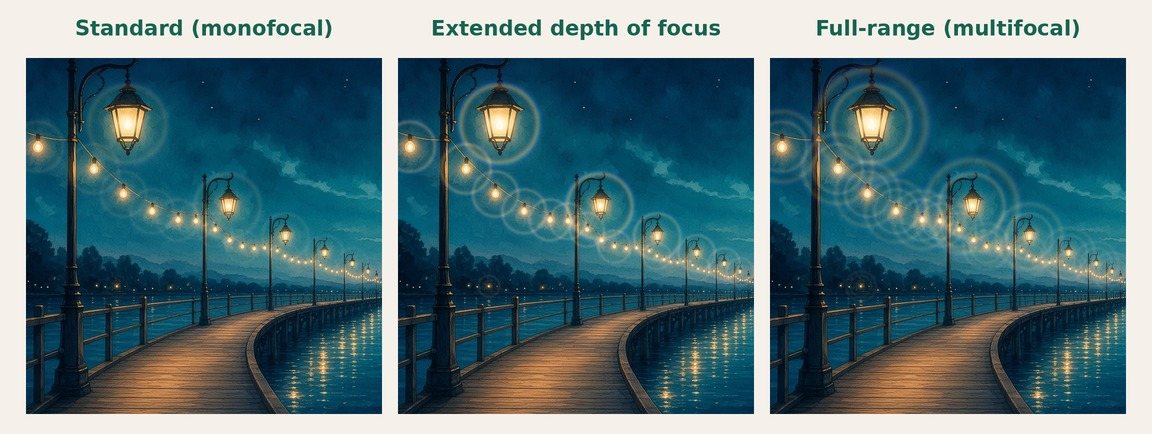
Low-light contrast. Contrast in dim light can be lower than with a monofocal, especially with some EDOF and full-range designs. The official label for one EDOF lens says most people who receive it are likely to have a significant loss of contrast compared with a monofocal, and should take care in dim light, including when driving at night.
Missing the target. With any of the three lens categories, the final focus can land a little off the planned target (sometimes called a refractive surprise). Options include glasses or contacts, a laser touch-up on the cornea, an adjustment if you have a light-adjustable lens, or, rarely, exchanging the lens; a question to ask is whether a touch-up is included.
Toric lenses may rotate. A toric lens has to be lined up at an exact angle. If a toric lens rotates out of position, it corrects less of the astigmatism, so your vision may not be as good as planned. A lens that rotates can sometimes be repositioned.
Monovision and depth perception. Depth perception may be lower than with both eyes set for the same distance. Some people adjust easily and some never do; if you've never tried it, ask whether you can test it with contact lenses before surgery.
Dry eye. Eyes can feel dry, scratchy, or watery after surgery. This is common and often improves, but existing dry eye can also become more noticeable and can blur vision.
Clouding of the capsule behind the lens (YAG). Months or years later, the thin capsule that holds the lens can become cloudy. This is a common later issue and can make vision hazy again or add glare; a brief laser procedure, called a YAG capsulotomy, can open a window in that membrane.
Swelling in the center of the retina (CME). Swelling in the center of the retina, called cystoid macular edema, can blur or distort central vision after surgery. It often improves with anti-inflammatory drops.
Floaters and retinal detachment. Some people notice new floaters after surgery. A sudden shower of floaters, flashes of light, or a curtain over your vision can be a sign of a retinal tear or detachment, which is uncommon but urgent — call your surgeon right away if that happens.
Lens shifting. The lens can shift or rotate out of position, which may blur vision and sometimes needs a further procedure. This is more likely if the supporting structures of the eye are weak.
Infection. Infection inside the eye is rare, but it is serious and can threaten vision. Call promptly for increasing pain, redness, discharge, or worsening vision in the days after surgery.
Adapting to a new lens. It can take time for your brain and eyes to adjust, especially with lenses designed for more than one distance. Some people adapt over a few weeks; others take longer.
Inflammation and pain. Some inflammation and mild discomfort are common after surgery and are usually treated with drops. Increasing pain, rather than steadily easing discomfort, is a reason to call your surgeon.
Rare vision loss. In rare cases, complications such as infection or bleeding can lead to lasting vision loss. This is uncommon, and it is one reason the warning signs in the recovery section matter.
Sources for this section: Halos and glare — the FDA studies of PanOptix (P040020/S087, Tables 20–21) and TECNIS Synergy (P980040/S124, Tables 16–17 and p. 32). Noticing a symptom and being bothered by it are different measures; some people reported symptoms that interfered with daily activities. Low-light contrast — Vivity labeling (P930014/S126, Warnings), PureSee SSED (P980040/S176, p. 57), and US enhanced-monofocal labeling. Findings differ by lens model. Missing the target — a large European registry found some eyes did not land at the planned focus (Lundström et al., 2018, PMID 29685779). Monovision depth perception — one study found depth perception decreased as the difference in focus between the two eyes increased (Hayashi et al., 2011, PMID 20839664).
Expectations and recovery
Most people recover over a period of weeks. With lenses designed for more than one distance, it can take around six to eight weeks to settle in at all ranges, and full recovery is often described as about three months. No current lens restores the focusing of a young eye, and you may still need glasses at times. Call your surgeon right away for sudden vision loss, increasing pain, flashes of light, or a curtain over your vision.
Some surgeons use a laser for part of the operation. A Cochrane review found little or no difference from standard surgery in complications, vision after surgery, or quality of life, and a laser is not required for any part of the procedure.
Source: Narayan et al., Cochrane Database of Systematic Reviews, 2023, PMID 37369549.
The second eye
The two eyes are usually operated on one to two weeks or more apart, though some systems do both on the same day. In between, the two eyes can feel unbalanced, especially if you had a strong glasses prescription; options can include taking the lens out of your old glasses for the operated eye, or wearing a contact in the other eye. The result in the first eye can guide the plan for the second.
Questions to bring to your consult
- Which lens categories are possible for my eyes, and why not the others?
- Do I have astigmatism? Is it regular, and is there enough for a toric lens to help? What other ways could we treat it?
- With each option, what will I still need glasses for?
- What measurements will you take, and does my eye surface need treatment first?
- Does anything about my eyes (LASIK, retina, glaucoma, cornea) rule out a lens type?
- If I land off target, what are my options, and is a touch-up included?
- How far apart will you do my two eyes, and how will I manage in between?
- Do you use a laser for any part of the surgery, and why?
- What are the halo, glare, dim-light and other risks with each option?
Want a fuller list, including goals, measurements, and what to ask if the focus lands off target? See Questions to ask your surgeon about cataract lenses.
Want to talk it through before the lens is implanted?
ClarityIQ is a guided voice conversation, built by a cataract surgeon, that walks you through these goals and lens categories at your own pace — before your consult, after it, or as a second look. You get a written summary to bring to your surgeon. Or start with our free guides, sent to your email.
Frequently asked questions
Is there one lens that's right for everyone?
No. Each lens category is designed for different goals, and each has different risks. Which one is right for you depends on what you want to see without glasses, how much halo, glare or contrast change you would accept, the health of your eyes, and your surgeon's exam.
Will I still need glasses after cataract surgery?
Maybe. With a monofocal lens, you'll need glasses for the ranges it isn't set for. Full-range lenses are designed so many people can do most of their day without glasses, but some still keep readers. How much your vision improves also depends on the health of the rest of your eye, and you may still need glasses for some tasks.
I'm nearsighted and read without glasses now, so I should pick distance, right?
Not necessarily. The natural lens that gives you near vision today is the one being removed, so the question is what you want your new focus to be, not what you have now. If a monofocal is aimed at distance, you'll likely need glasses to read. If it is aimed at near, you can often keep reading without glasses, but you'll need glasses for distance. This page does not tell you which to pick.
Do all lenses cause halos and glare?
Any lens can cause halos and glare, monofocals included, and they are more common with full-range lenses. Most people notice more halos. Most aren't very bothered by them, and some are. Ask your surgeon how that applies to the lenses you are considering.
What if the focus lands off the planned target?
With any of the three lens categories, the final focus can land a little off the planned target. Options include glasses or contacts, a laser touch-up on the cornea, an adjustment if you have a light-adjustable lens, or, rarely, exchanging the lens. Ask your surgeon: if I land off target, what are my options, and is a touch-up included?
Can the lens be changed later?
Replacing a lens is possible, but it means another surgery with its own risks. It's best to think of your choice as permanent.
Does ClarityIQ tell me which lens to choose?
No. ClarityIQ explains what each lens category is designed to offer and its risks, so you can have a better conversation with your surgeon. You and your surgeon make the choice together.
Sources
The figures in the Risks section come from the FDA documents and peer-reviewed papers listed below. Studies used different questionnaires, so the percentages should not be averaged or ranked against each other.
- AcrySof IQ PanOptix, PMA P040020/S087: SSED (Tables 20–21) and FDA information brochure (Tables 4–5).
- TECNIS Synergy, PMA P980040/S124: SSED (Tables 16–17, pp. 28 and 32).
- enVista Envy, PMA P240005: SSED (pp. 29 and 37).
- AcrySof IQ Vivity, PMA P930014/S126: SSED (Table 21, p. 51) and labeling (Warnings, including contrast).
- TECNIS Symfony, PMA P980040/S065: SSED (Tables 18–19).
- TECNIS PureSee, PMA P980040/S176: SSED (p. 31, Table 22, p. 57).
- Light Adjustable Lens, PMA P160055: SSED and professional labeling (indications, contraindications, UV-protective eyewear, and two lock-in treatments).
- Lundström M, Dickman M, Henry Y, Manning S, Rosen P, Tassignon MJ, Young D, Stenevi U. Risk factors for refractive error after cataract surgery: analysis of 282,811 cataract extractions reported to the European Registry of Quality Outcomes for Cataract and Refractive Surgery. Journal of Cataract & Refractive Surgery. 2018;44(4):447-452. PMID 29685779. doi:10.1016/j.jcrs.2018.01.031.
- Hayashi K, Yoshida M, Manabe S, Hayashi H. Optimal amount of anisometropia for pseudophakic monovision. Journal of Refractive Surgery. 2011;27(5):332-338. PMID 20839664. doi:10.3928/1081597X-20100817-01.
- Zhang L, Lin D, Wang Y, Chen W, Xiao W, Xiang Y, Zhu Y, Chen C, Dong X, Liu Y, Chen W, Lin H. Comparison of visual neuroadaptations after multifocal and monofocal intraocular lens implantation. Frontiers in Neuroscience. 2021;15:648863. PMID 34194292. doi:10.3389/fnins.2021.648863.
- Rosa AM, Miranda ÂC, Patrício MM, McAlinden C, Silva FL, Castelo-Branco M, Murta JN. Functional magnetic resonance imaging to assess neuroadaptation to multifocal intraocular lenses. Journal of Cataract & Refractive Surgery. 2017;43(10):1287-1296. PMID 29120714. doi:10.1016/j.jcrs.2017.07.031.
- Narayan A, Evans JR, O'Brart D, Bunce C, Gore DM, Day AC. Laser-assisted cataract surgery versus standard ultrasound phacoemulsification cataract surgery. Cochrane Database of Systematic Reviews. 2023;6:CD010735. PMID 37369549. doi:10.1002/14651858.CD010735.pub3.
This page is education, not medical advice. It doesn't diagnose anything or tell you which lens to choose, and it doesn't create a doctor-patient relationship. Your surgeon decides with you, based on your exam.